Page 1 of the original document
SEM lækningar slf. Stefán E. Matthíasson dr. med. Diagnosis and treatment of surgical and vascular diseases Lágmúla 5, 2nd floor, 108-Reykjavík, Tel.: 590 9200, www.laekning.is
The vascular system. The body's vascular system can be divided into three parts:
- Arteries
- Veins
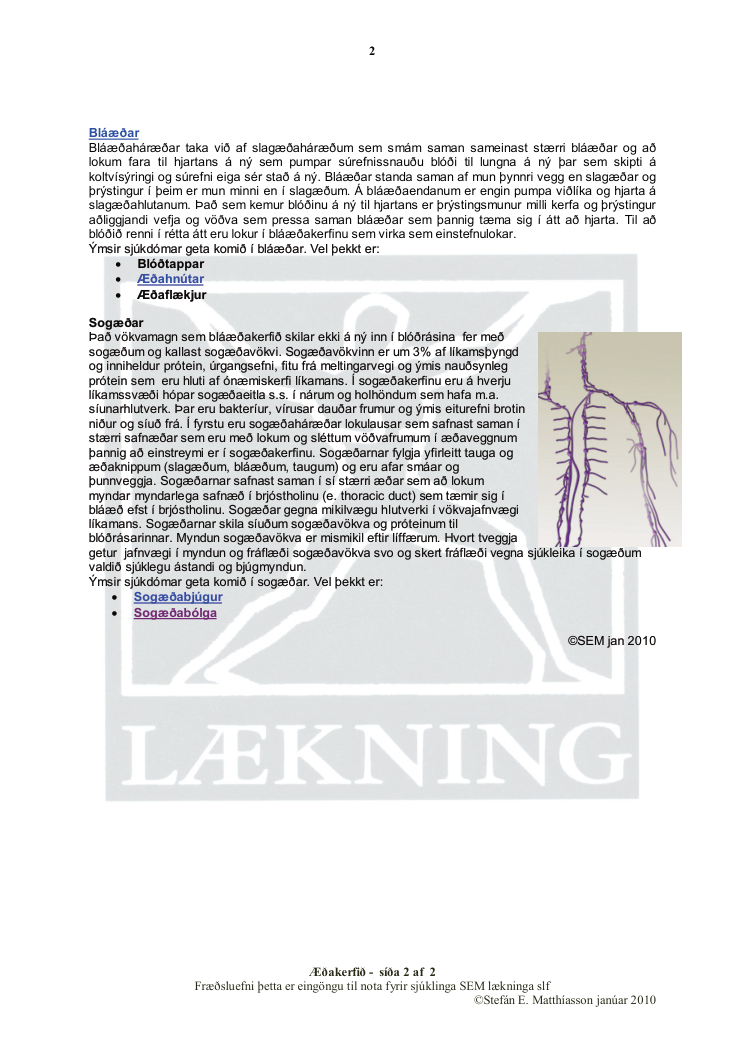
- Lymphatic vessels. These vessels form a complex network that works together in all the body's organs. Diseases can affect all these systems and then have symptoms specific to each vascular system. Arteries. The heart pumps oxygen-rich blood, which has passed through the pulmonary circulation and taken up oxygen, out to the body's organs through the arteries. Arteries consist of 3 layers. The innermost is the endothelium, followed by the middle layer, and outermost is the supporting structure of the vessel, the adventitia. The heart pumps blood to the organs using its pumping force and at high pressure. Blood pressure is measured as an upper and lower value. The upper value is the pressure when the pulse wave is sent from the heart following its contraction. The lower value is the pressure in the vessels between heartbeats. Normal pressure in adults is lower than 120-140 mmHg for the upper value and 60-80 mmHg for the lower value. The arteries branch into increasingly smaller vessels and eventually into capillaries. Oxygen, carbon dioxide, and nutrients are exchanged with the tissues there. Various diseases can affect the arteries. One is atherosclerosis (e. Atheroscerosis). This disease originates in the innermost part of the vessels, the endothelium, and later spreads to the middle layer. Several contributing factors cause damage to the endothelium. An inflammatory response, accumulation of cholesterol (fat-filled macrophages), proliferation of smooth muscle cells, activity of certain white blood cells (macrophages), and adhesion of platelets and other blood components produce plaques in the vessel wall that can narrow or completely block the vessel. These plaques may be soft and without calcium or hard and contain calcium. Atherosclerosis can begin early in life and is a progressive disease. The name atherosclerosis applies to both. The consequences depend on which vascular system is involved:
- Coronary arteries → angina/coronary artery blockage → myocardial infarction
- Cerebral vessels → ischemia/stroke → aphasia/paralysis, etc.
- Peripheral arteries → ischemia → pain when walking (intermittent claudication)/tissue necrosis
- Aneurysmal disease may also occur. The main risk factors for atherosclerosis are:
- Age
- Family history
- Diabetes
- Hypertension
- High blood lipids
- Smoking
- Obesity
- Physical inactivity
The vascular system – Page 1 of 2. This educational material is for patients only. SEM lækninga slf. ©Stefán E. Matthíasson January 2010
View the original page and images
Page 2 of the original document
2
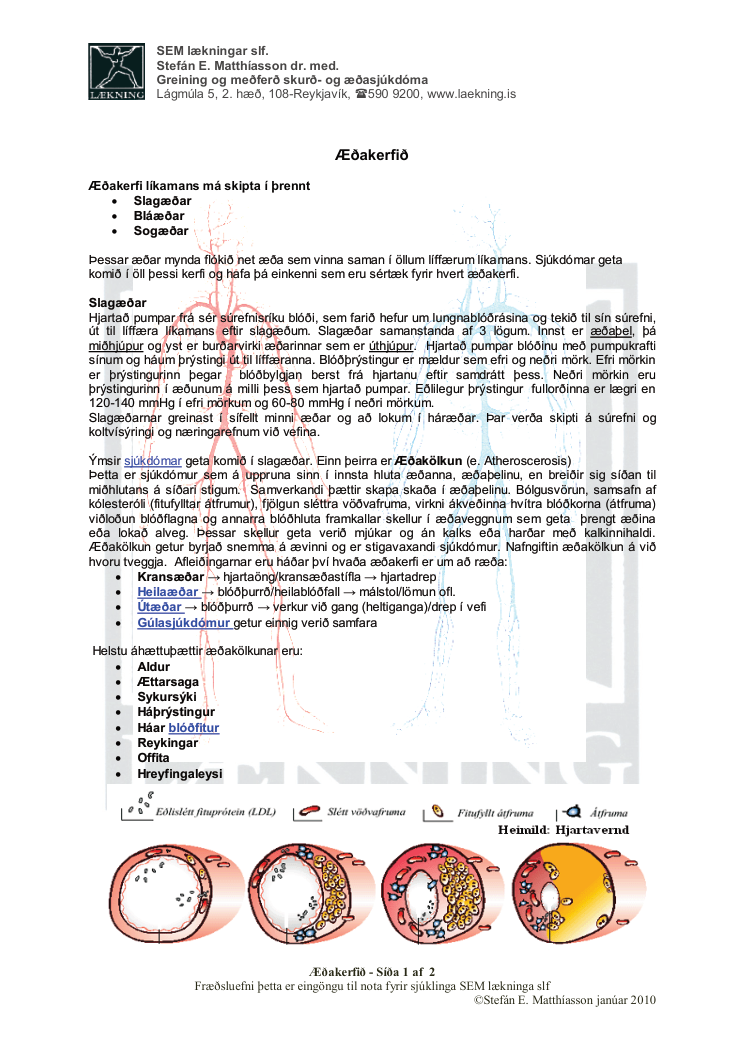
Veins. Venous capillaries continue from arterial capillaries and gradually join into larger veins, eventually returning to the heart, which pumps oxygen-poor blood to the lungs again, where carbon dioxide and oxygen are exchanged once more. Veins have much thinner walls than arteries, and the pressure in them is much lower than in arteries. At the venous end, there is no pump comparable to the heart on the arterial side. Blood returns to the heart because of pressure differences between systems and pressure from surrounding tissues and muscles, which compress the veins so that they empty toward the heart. Valves in the venous system ensure that blood flows in the correct direction and act as one-way valves. Various diseases can affect the veins. Well-known ones include:
- Blood clots
- Varicose veins
- Vascular malformations. Lymphatic vessels. The fluid that the venous system does not return to the bloodstream travels through the lymphatic vessels and is called lymphatic fluid. Lymphatic fluid is about 3% of body weight and contains protein, waste products, fat from the digestive tract, and various essential proteins that are part of the body's immune system. In each area of the body, groups of lymph nodes are found in the lymphatic system, such as in the groin and armpits, where they perform, among other things, a filtering function. Bacteria, viruses, dead cells, and various toxins are broken down and filtered out there. Initially, lymphatic capillaries have no valves; they join into larger collecting vessels that have valves and smooth muscle cells in their walls, so flow in the lymphatic system is one-way. Lymphatic vessels usually run alongside nerve and vessel bundles (arteries, veins, nerves) and are very small and thin-walled. They join into increasingly larger vessels that eventually form a large collecting vessel in the chest (e. thoracic duct), which empties into a vein in the upper chest. Lymphatic vessels play an important role in the body's fluid balance. They return filtered lymphatic fluid and proteins to the bloodstream. The amount of lymphatic fluid produced varies between organs. An imbalance between production and drainage of lymphatic fluid, as well as impaired drainage due to disease in the lymphatic vessels, can cause a pathological condition and edema. Various diseases can affect the lymphatic vessels. Well-known ones include:
- Lymphedema
- Lymphangitis
©SEM Jan 2010
The vascular system – Page 2 of 2. This educational material is for patients only. SEM lækninga slf. ©Stefán E. Matthíasson January 2010
View the original page and images