Before surgery
Do not smoke or use nicotine pouches for 2 hours before surgery.
Page 2 in the PDF · page 1 of the original document
Brynjólfur Y. Jónsson, physician. Lækning, Lágmúla 5, 108 Reykjavík tel.: 590 9200, 897 8783 brynjons@mmedia.is, www.laekning.is 1st floor on the left. tel. 553.2040
Useful information for knee arthroscopy. Reason for surgery: Knee arthroscopies are performed for diagnosis, although such procedures have become less common since the introduction of magnetic resonance imaging. However, arthroscopy may be necessary if the history, examination, and magnetic resonance imaging do not provide sufficient information. By far the most common reason for knee arthroscopy is to remove various abnormal structures from the knee, such as a torn meniscus, loose bodies, and synovial folds. Larger repairs, e.g. of cruciate ligaments, can also be performed arthroscopically. Preparation. The knee, like all other joints, is particularly susceptible to infection. Arthroscopy is therefore performed under sterile conditions. Before surgery is performed, the following must be observed:
1. The skin on the knee must be healthy and intact. 2. There must be no rash, swelling, or wounds on the knee or in its immediate vicinity
except for psoriasis rashes. 3. The patient's general condition must be good. It is therefore not advisable to
perform surgery if the patient has an infection, e.g. a fever or a bad cold. 4. Shower on the morning of the day of surgery and the evening before, and wash the entire body
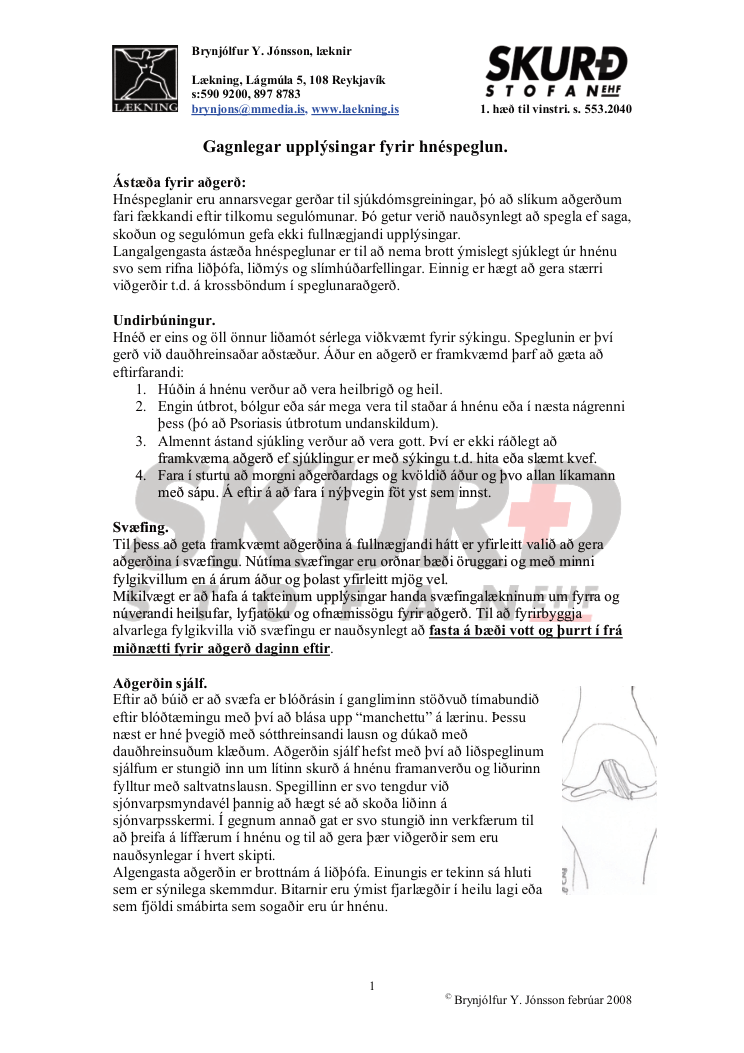
with soap. Afterward, put on freshly washed clothes, from the inside out. Anesthesia. To perform the procedure adequately, it is usually chosen to do it under general anesthesia. Modern anesthesia has become both safer and associated with fewer complications than in the past, and is generally very well tolerated. Before surgery, it is important to have information ready for the anesthesiologist about your past and current health, medications, and allergy history. To prevent serious complications from anesthesia, you must fast from all food and drink from midnight before the procedure the following day. The procedure itself. After anesthesia has been administered, circulation to the leg is temporarily stopped after draining the blood, by inflating a “cuff” around the thigh. The knee is then washed with an antiseptic solution and draped with sterile cloths. The procedure begins by inserting the arthroscope through a small incision at the front of the knee and filling the joint with saline solution. The scope is then connected to a television camera so that the joint can be viewed on a monitor. Instruments are inserted through another opening to examine the structures in the knee and perform whatever repairs are necessary in each case. The most common procedure is removal of part of the meniscus. Only the part that is visibly damaged is removed. The pieces are either removed whole or as many small pieces that are suctioned out of the knee.
1
© Brynjólfur Y. Jónsson February 2008
View the original page and images
Page 3 in the PDF · page 2 of the original document
At the end of the procedure, the joint is drained and the puncture sites are stitched. Local anesthetic is injected under the skin at the puncture sites to reduce pain as the anesthesia wears off. Finally, a light dressing is placed on the knee. After surgery. You may go home as soon as your general condition allows. Usually, the person can go home 2-3 hours after waking. Full weight-bearing on the operated leg is permitted unless the surgeon states otherwise. Crutches can often make it easier to get around during the first few days after surgery. It may therefore be worth asking whether a friend or family member has such equipment that you can borrow for a short time. Otherwise, crutches can be bought for relatively little money at pharmacies and from orthotists or rented from Hjálpartækjabankinn. Leave the dressings undisturbed on the knee for the first 1-2 days. After that, they may be removed and you may shower (note: do not take a bath or go swimming). It does not matter if the surgical wounds get wet, as long as they are dried with a clean towel and covered with a good adhesive dressing afterward. Possible complications:
1. Swelling and fluid in the joint are the most common complications after arthroscopy. This presents as swelling and limited movement. If fluid formation is painful or prolonged, the joint should be drained by aspiration. 2. Blood clot formation (a blood clot) is uncommon and presents as pain in the calf, swelling, and warmth. Seek a doctor's assessment as soon as possible if a blood clot is suspected. 3. Joint infection is very rare after knee arthroscopy (ca 0.25%), but is nonetheless dangerous and usually requires urgent admission to a medical facility and further treatment. Symptoms include a high fever, pain, swelling in the knee, redness, and sometimes discharge of pus from the puncture sites. Follow-up. Follow-up is arranged in consultation with the surgeon. Stitches are removed 7-10 days after surgery, and this can be done at the nearest health clinic. It is usually better to have a final follow-up 4-6 weeks after the procedure to see what the outcome has been. Exceptions must, of course, be made if a complication is suspected earlier; in that case, the patient is encouraged to contact the surgeon and will be called in for follow-up as soon as circumstances require.
2 © Brynjólfur Y. Jónsson February 2008
View the original page and images