Page 1 of the original document
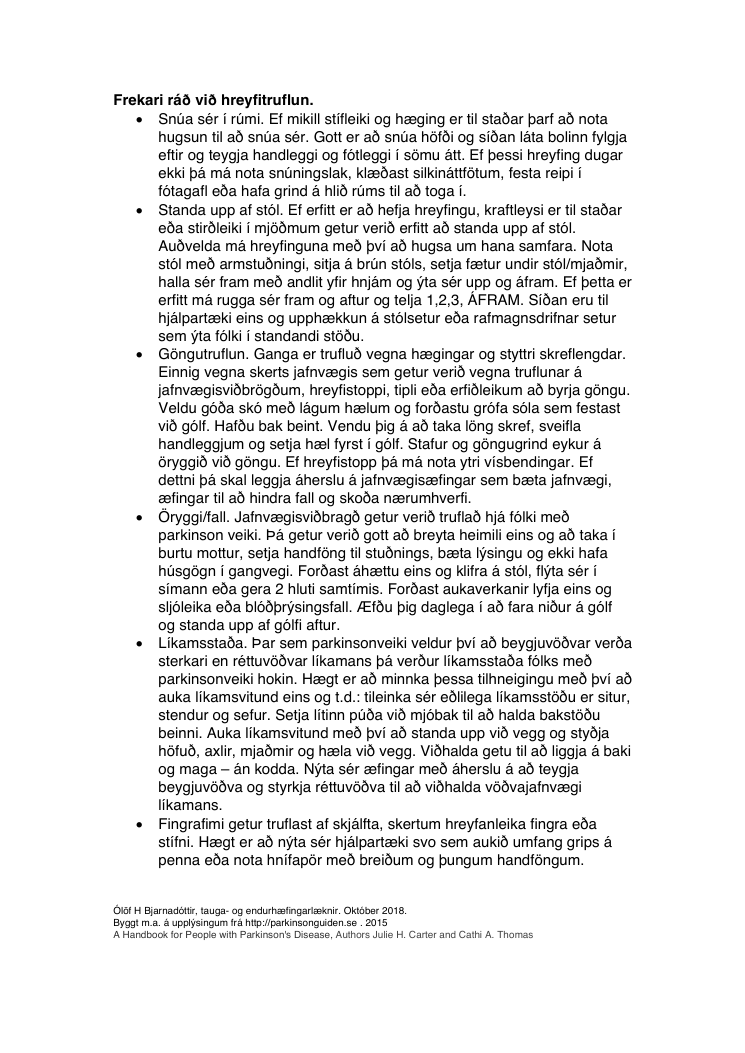
Parkinson's disease – everyday tips. What you can do yourself is:
- Take medication at the right time. Take Sinemet or Madopar (L-dopa) 30 minutes before a meal or 30 min. after food. If you forget a dose, it is recommended to wait until the next scheduled time rather than taking 2 doses close together. A phone reminder is available, e.g. medisafe.com.
- Pay attention to how you take medication. You may drink water with medication, but there is no need to drink a full glass of water each time if medication is taken more than x4/day, especially if you have urinary incontinence. Do not take Parkinson's medication with dairy products, because protein inhibits absorption of L-dopa in the intestine. You may take the medication with a biscuit if your stomach is sensitive. Raisins or fruit may increase L-dopa absorption.
- Take care of yourself. Do something every day that makes you feel good or that you enjoy.
- Avoid stress. Expect everything you do to take longer. Prepare well for what you need to do and try to develop flexibility – that is, tasks do not have to be done exactly as they were before. Sometimes it is better to do tasks when you feel better during the day or in connection with medication doses.
- Maintain cognitive function. The brain needs exercise just like muscles. Examples of mental exercise include crossword puzzles, reading books, and discussing topics of interest. The brain also needs rest, for example through relaxation and, not least, a good night's sleep.
- Prevent freezing of movement. Imagine that there is an obstacle or a staircase in front of you that you need to step over or onto. You can also clap your thigh or count out loud to initiate movement.
- Prevent falls. Most falls occur at home. Falls can be prevented there by keeping a phone accessible, removing all loose rugs, removing thresholds, and securing cables to the walls. Wear slippers with heel straps that stay firmly on your feet, and have non-slip protection in the bath/shower along with a handrail there and by the toilet. Outdoors in icy conditions, it is recommended to use ice grips.
- Adopt positive thinking. Our quality of life depends largely on how we respond to events around us and how solution-focused we are in different situations. It can be difficult when negative thoughts arise, and sometimes it is hard to push them aside. One example is to write down a few things you find enjoyable or pleasant, such as walking in nature, having tea/coffee at home or in a café, gardening, or seeing grandchildren. When negative thoughts arise, you can read what you have written; this may help you see a glimmer of light when difficulties arise.
View the original page and images
Page 2 of the original document
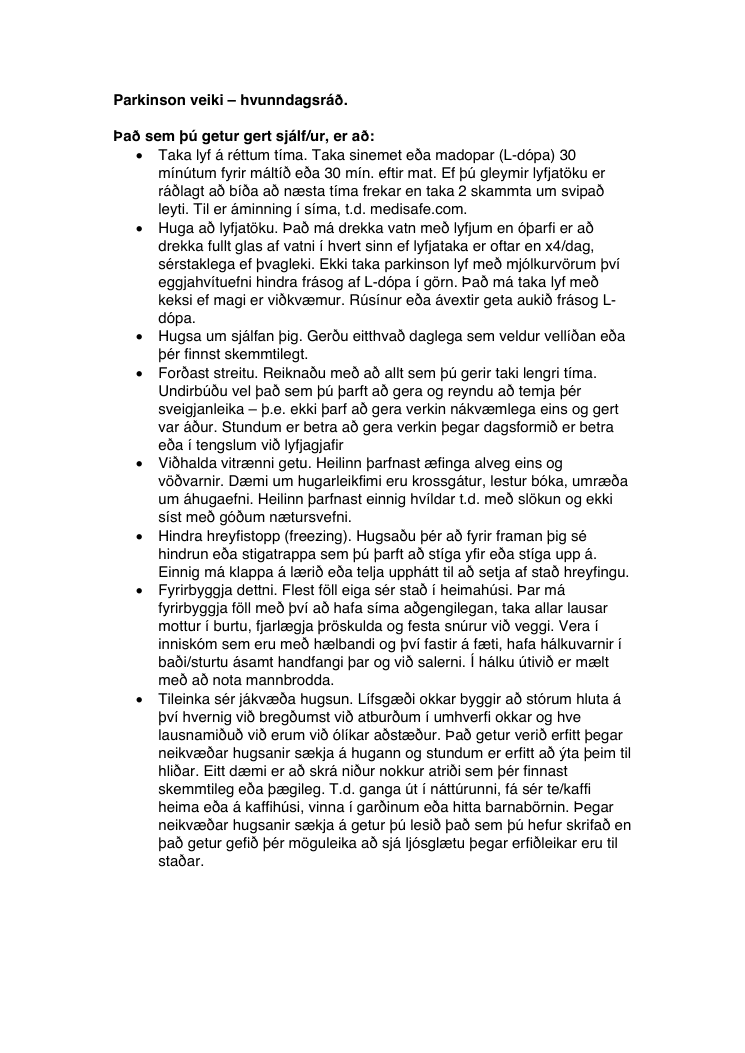
Further advice for movement disorders.
- Turning over in bed. If there is severe stiffness and slowness, you need to use your mind to turn over. It is helpful to turn your head first and then let your torso follow, and stretch your arms and legs in the same direction. If this movement is not enough, you can use a turning sheet, wear silk pajamas, attach a rope to the foot of the bed, or have a bed rail on the side to pull on.
- Getting up from a chair. If it is difficult to initiate movement, there is weakness, or there is stiffness in the hips, it may be difficult to get up from a chair. The movement may be made easier by thinking it through as you do it. Use a chair with armrests, sit on the edge of the chair, place your feet under the chair/hips, lean forward with your face over your knees, and push yourself up and forward. If this is difficult, rock back and forth and count 1,2,3, GO. There are also assistive devices such as seat raisers or powered seats that push people into a standing position.
- Walking difficulties. Walking is affected by slowness and shorter strides. It is also affected by impaired balance, which may result from impaired balance reactions, freezing, shuffling, or difficulty starting to walk. Choose good shoes with low heels and avoid rough soles that catch on the floor. Keep your back straight. Get used to taking long steps, swinging your arms, and placing your heel on the floor first. A cane or walker increases safety while walking. If freezing occurs, external cues may be used. If falls occur, emphasize balance exercises that improve balance, exercises to prevent falls, and assess the surroundings.
- Safety/falls. Balance reactions may be impaired in people with Parkinson's disease. It may help to modify the home by removing rugs, installing handrails for support, improving lighting, and keeping furniture out of walkways. Avoid risks such as climbing on a chair, rushing to answer the phone, or doing 2 things at the same time. Avoid medication side effects such as drowsiness or a drop in blood pressure. Practice getting down onto the floor and standing up again every day.
- Posture. Because Parkinson's disease causes the flexor muscles to become stronger than the body's extensor muscles, people with Parkinson's disease develop a stooped posture. This tendency can be reduced by increasing body awareness, for example by adopting normal posture when sitting, standing, and sleeping. Place a small pillow at the lower back to keep the back straighter. Increase body awareness by standing against a wall and resting the head, shoulders, hips, and heels against the wall. Maintain the ability to lie on the back and stomach – without a pillow. Use exercises that emphasize stretching the flexor muscles and strengthening the extensor muscles to maintain the body's muscle balance.
- Fine finger movements may be impaired by tremor, reduced finger mobility, or stiffness. Assistive devices may be useful, such as increasing the grip size on a pen or using cutlery with wide, heavy handles. Ólöf H Bjarnadóttir, neurologist and rehabilitation physician. October 2018. Based in part on information from http://parkinsonguiden.se . 2015 A Handbook for People with Parkinson's Disease, Authors Julie H. Carter and Cathi A. Thomas
View the original page and images