Page 1 of the original document
SEM lækningar slf. Stefán E. Matthíasson dr. med. Diagnosis and treatment of surgical and vascular diseases Lágmúla 5, 2nd floor, 108-Reykjavík, Tel.: 590 9200, www.laekning.is
Lymphedema. The fluid that the venous system does not return to the bloodstream travels through the lymphatic vessels and is called lymphatic fluid. Lymphatic fluid is about 3% of body weight and contains protein, waste products, fat from the digestive tract, and various essential proteins that are part of the body's immune system. In each area of the body, groups of lymph nodes are found in the lymphatic system, such as in the groin and armpits, where they perform, among other things, a filtering function. Bacteria, viruses, dead cells, and various toxins are broken down and filtered out there. Initially, lymphatic capillaries have no valves; they join into larger collecting vessels that have valves and smooth muscle cells in their walls, so flow in the lymphatic system is one-way. Lymphatic vessels usually run alongside nerve and vessel bundles (arteries, veins, nerves) and are very small and thin-walled. They join into increasingly larger vessels that eventually form a large lymphatic collecting vessel in the chest (e. thoracic duct), which empties into a vein in the upper chest. Lymphatic vessels play an important role in the body's fluid balance. They return filtered lymphatic fluid and proteins to the bloodstream. The amount of lymphatic fluid produced varies between organs. An imbalance between production and drainage of lymphatic fluid, as well as impaired drainage due to disease in the lymphatic vessels, can cause a pathological condition and lymphedema (e. lymphedema). Lymphedema and other vascular diseases. Lymphatic diseases must be distinguished from other vascular diseases. There is no direct association between lymphatic diseases and venous varicose veins, atherosclerosis, peripheral artery disease, carotid artery disease, or aneurysmal disease of the arteries. The risk factors and symptoms are different. Venous diseases are also a separate group of diseases, although edema may accompany the above groups of diseases for different reasons. Lymphedema is the accumulation of lymphatic fluid in the spaces between the body's tissue cells. Lymphedema develops because drainage is insufficient or production is increased to the point that drainage cannot handle the amount produced. This may occur, for example, with cirrhosis, severe reflux disease in the veins of the legs, or advanced kidney failure. Protein-rich lymphatic fluid then accumulates in a specific area, further increasing fluid accumulation. This affects the oxygenation of the affected tissues and impairs healing of tissue damage and wounds. It thereby promotes favorable conditions for microbial growth and infections, lymphangitis (e. lymphangitis). In advanced lymphedema, growth in the lymphatic network may occur, which can contribute to malignant growth, lymphatic cancer (e. lymphangiosarkoma). Lymphedema is an incurable disease that one must learn to live with, like any other chronic disease. Treatment aims to reduce symptoms and prevent side effects. Lymphedema is divided into two types according to cause:
- Primary lymphedema. Lymphatic vessels are absent or defective (e. primary) from the outset, or the cause is unknown. It may be congenital, appear at a young age (e. praecox), or appear in adulthood (e. tarda), and may affect one or more limbs.
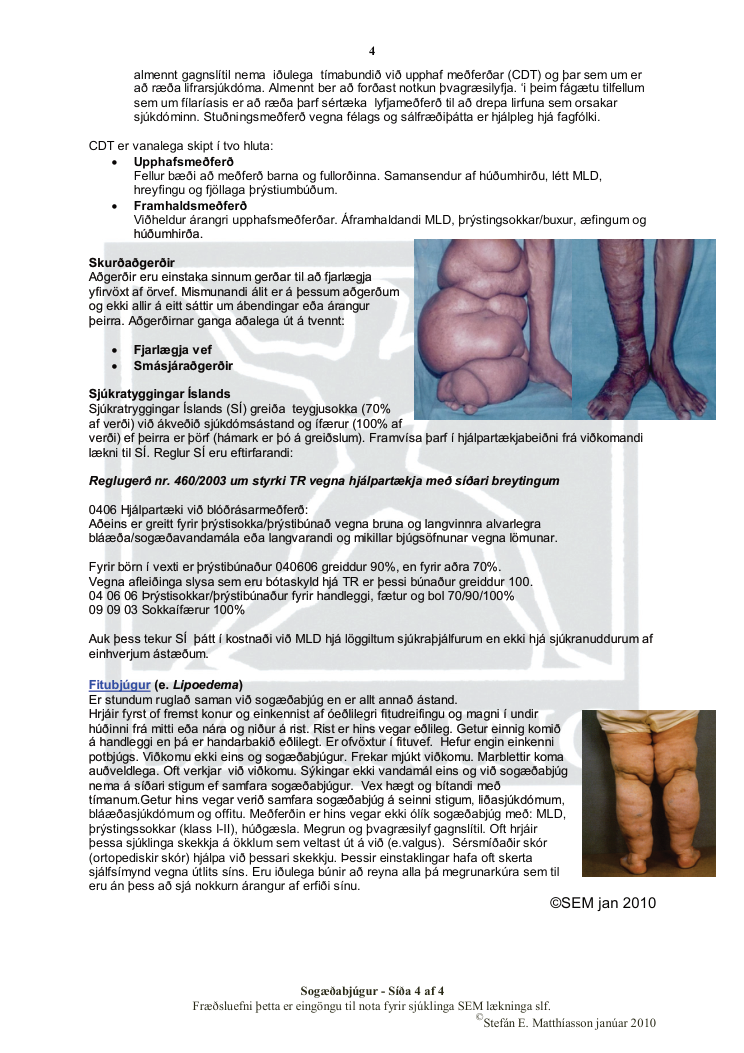
- Secondary lymphedema. Lymphatic vessels or nodes are damaged because of other diseases and therefore do not function properly (e. secondary). The most common causes are infections, surgery in which lymph nodes are removed, radiation, or drug treatment. It is most commonly seen in women after breast surgery and subsequent radiation treatment. It may also occur as a complication of other diseases, such as advanced venous disease, burns, or sunburn. Lymphangitis due to infections can damage lymphatic pathways and nodes and thus cause the disease. Its most severe form is infection caused by filarial larvae, transmitted by mosquito bites in Southeast Asia, India, and Africa. Filariasis is a consequence of this and is also widely called elephantiasis because of the massive swelling of the legs and/or genitals or other parts of the body. Different appearances of edema:
Lymphedema – Page 1 of 4. This educational material is for patients only. SEM lækninga slf.
©Stefán E. Matthíasson January 2010
View the original page and images
Page 2 of the original document
2
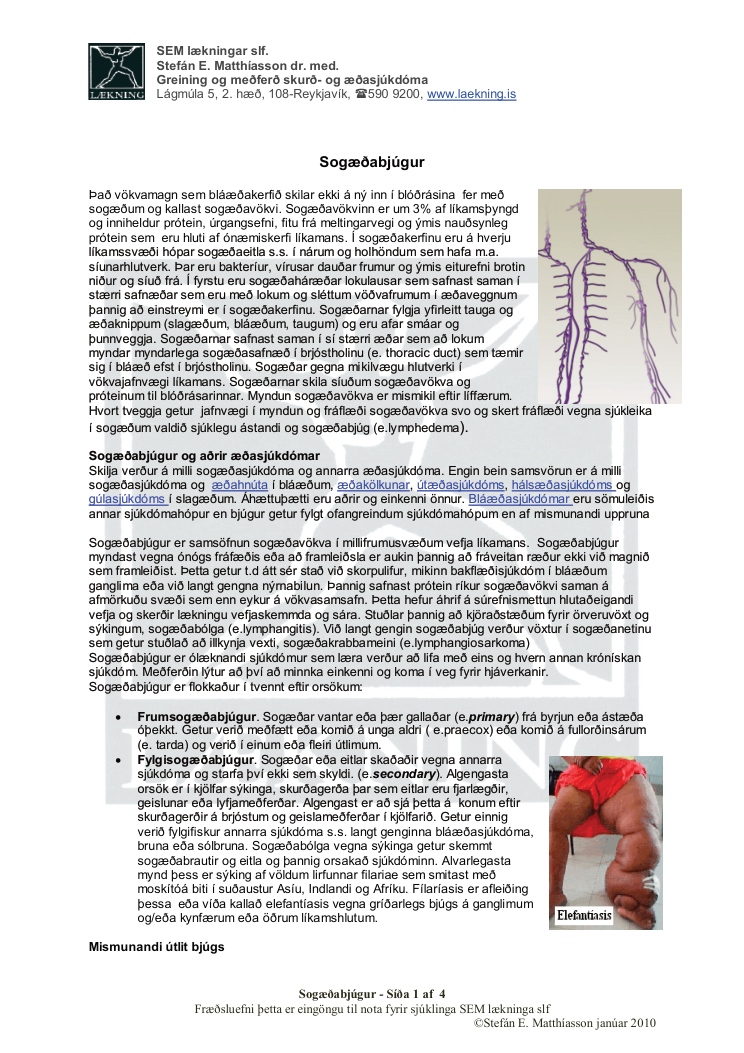
There are numerous diseases that cause swelling in parts of the body. The causes are as varied as the many diseases. This is not necessarily due to lymphatic problems. Edema is distinguished according to how it responds to external pressure when a finger is pressed on it for a while and then released. It is best to do this, for example, on the front of the shin or the top of the foot. If an indentation remains in the skin after releasing the pressure, this is called pitting edema (e. pitting odema). If pressure does not leave an indentation, it is called non-pitting edema (e. non-pitting odema). Lymphedema is non-pitting in later stages but may be pitting at the start of symptoms (Stage I). Other types are usually pitting edema, for example, edema due to heart failure. Symptoms of lymphedema. Lymphedema can develop in almost any part of the body or a portion of it. Symptoms include increased size and tightness in the affected area. The disease is classified into three stages according to severity (I-III), and more recently also a pre-stage 0:
- Stage 0: A preclinical stage in which the tendency to develop edema is slight and may persist for months or several years.
- Stage I: Early symptoms are present, with pitting edema. Symptoms are mild, and the edema may subside overnight or may increase while standing, either completely or to a considerable extent. Symptoms are generally easy to manage.
- Stage II: Persistent symptoms that do not resolve when the legs are elevated or subside overnight. Non-pitting edema and tissues with a firm, spongy feel. Early fibrosis in the tissues.
- Stage III: Persistent edema and a substantial increase in limb size. The tissues feel hard, and fibrosis is considerable. Scaling (e. acanthosis) of the skin may occur, as may fissures, wart-like skin changes, ulcers, and infections.
- Subcategories: Stages I–III are often further classified into three groups according to treatment response:
o Mild: <20% increase in volume o Moderate: 20-40% increase in volume o Severe: >40% increase in volume Diagnosis An accurate diagnosis of the disease is important. The term is often used loosely even when there is no evidence that the symptoms are of lymphatic origin. It can often take some time before a definitive diagnosis is made and other possible causes have been ruled out. This applies especially to early symptoms, stages 0-I. The main diagnostic tools for the disease are:
- Detailed medical history
- Physical examination
- Blood tests
- Imaging It is important to consider other causes of edema. Further diagnostic methods are used to rule these out or to determine the precise location and causes of the disease. The main possibilities include:
- Obesity
- Heart failure
- Hypertension
- Venous diseases
- Cerebrovascular and arterial diseases
- Injuries/accidents
- Liver diseases
- Kidney diseases
- Malignancy
- Thyroid diseases
Lymphedema - Page 2 of 4 Educational material intended solely for use by patients of SEM lækninga slf. ©Stefán E. Matthíasson January 2010
View the original page and images
Page 3 of the original document
3
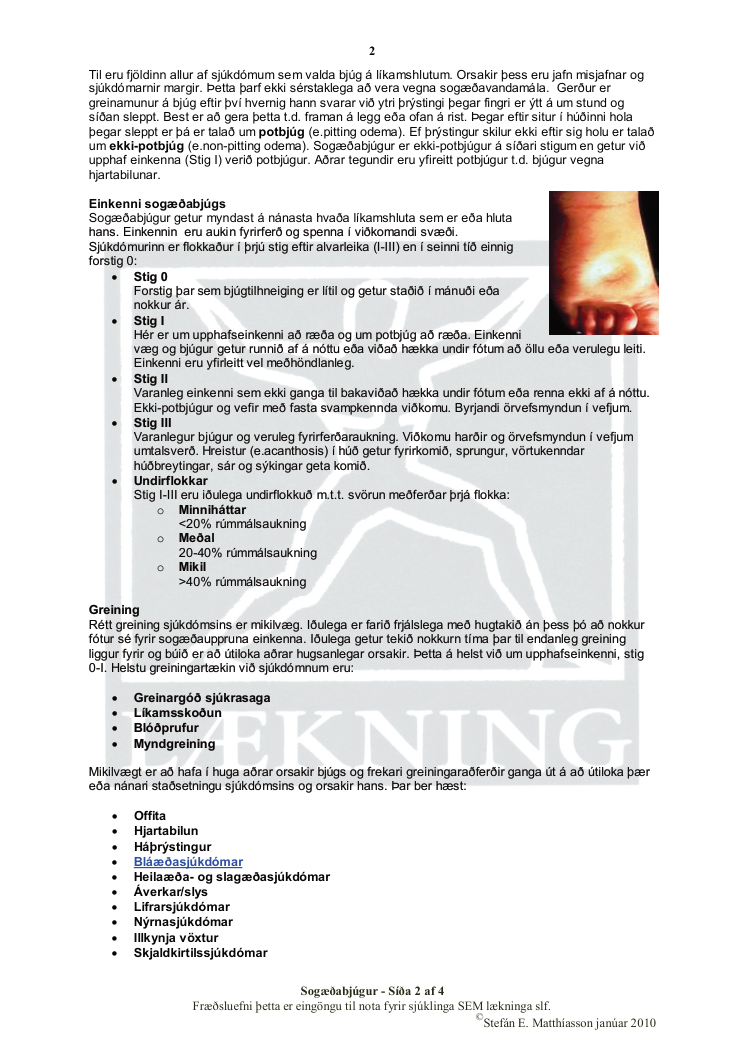
Imaging The main procedures used today are listed below. It should be noted that lymphangiography (e. lymphangiography) was formerly the main diagnostic method. An oil-based contrast agent was injected and followed. When successful, this was useful, but it often did not go well, making the examination of little value. More recently, new methods have become available with advances in imaging.
- Lymphoscintigraphy (e. lymphangioscintigraphy) A radioactive isotope (Tc-99) is injected into the tissues and taken up by the body's lymphatic vessels. This makes it possible to assess lymphatic function and possible obstructions to drainage. The isotope accumulates where there is the most lymphatic fluid.
- Ultrasound Used primarily to distinguish venous diseases.
- CT/MRI Used to rule out malignancy and also when an injury is suspected as the cause of symptoms. Genetics Genetic testing is necessary when investigating primary lymphedema and when there is a family history. The main mutations involved are those associated with lymphedema-distichiasis (FOXC2) and the congenital lymphatic system defect Milroy disease (VEGFR-3). Biopsy Fine-needle aspiration may be necessary to rule out malignancy. Treatment of lymphedema Treatment aims to reduce symptoms and prevent complications. Treatment can mainly be divided into two:
- Conservative treatment
- Surgery Conservative treatment Complex decongestive therapy (e. Complex Decongestive Therapy (CDT)) consists of:
- Manual lymphatic drainage (e. manual lymphatic drainage – MLD) This is a specialized technique that requires skill and experience to perform. It is performed by specially trained physiotherapists or massage therapists who have focused on and learned this technique. Ordinary massage is ineffective.
- Appropriate bandaging
- Skin care and exercise Skin cleansing, emollient cream with a low pH, exercise and mobility training, and elevating the limb at rest/at night.
- Compression stockings and compression trousers, if applicable. Usually class III-IV (>30mmHg compression pressure). The higher the compression pressure that can be tolerated, the better the result. It is often necessary to change from day to day. Patients must have access to several different compression stockings/trousers. These stockings usually need to be custom-made to fit the needs of the individual. The limb must be measured precisely before they are made. Adjustable compression wraps are also useful. These are special stockings that can be tightened with Velcro (e. velcro fitting compression). Pumps (e. Intermittent pneumatic compression) are available that apply a massaging pressure to the limbs and thus mimic MLD. This is often useful at the start of treatment, but it also has disadvantages. It is also an expensive option.
- Physical exercise
- Preventive measures Diet has not been shown to be of major importance, nor has limiting fluid intake. For those who are overweight, the same applies as for others. Medication should be used freely when infections are present. These are often skin bacteria that respond to penicillin treatment or treatment for staphylococci (Staklox®, Diclocil®). Fungal infections often respond to topical antifungal cream or tablets, Diflucan® or Lamisil®. The use of diuretics is
Lymphedema - Page 3 of 4 Educational material intended solely for use by patients of SEM lækninga slf. ©Stefán E. Matthíasson January 2010
View the original page and images
Page 4 of the original document
4
generally of little benefit except, often temporarily, at the beginning of treatment (CDT) and in cases of liver disease. In general, the use of diuretics should be avoided. ‘In the rare cases of filariasis, specific drug treatment is needed to kill the larva that causes the disease. Supportive care for social and psychological factors is helpful when provided by professionals. CDT is usually divided into two phases:
- Initial treatment Applies to both children and adults. Consists of skin care, gentle MLD, exercise, and multilayer compression bandaging.
- Maintenance treatment Maintains the results of the initial treatment. Continued MLD, compression stockings/trousers, exercise, and skin care. Surgery Surgery is occasionally performed to remove excess fibrotic tissue. Opinions differ about these procedures, and there is no consensus about their indications or results. The procedures mainly involve two approaches:
- Tissue removal
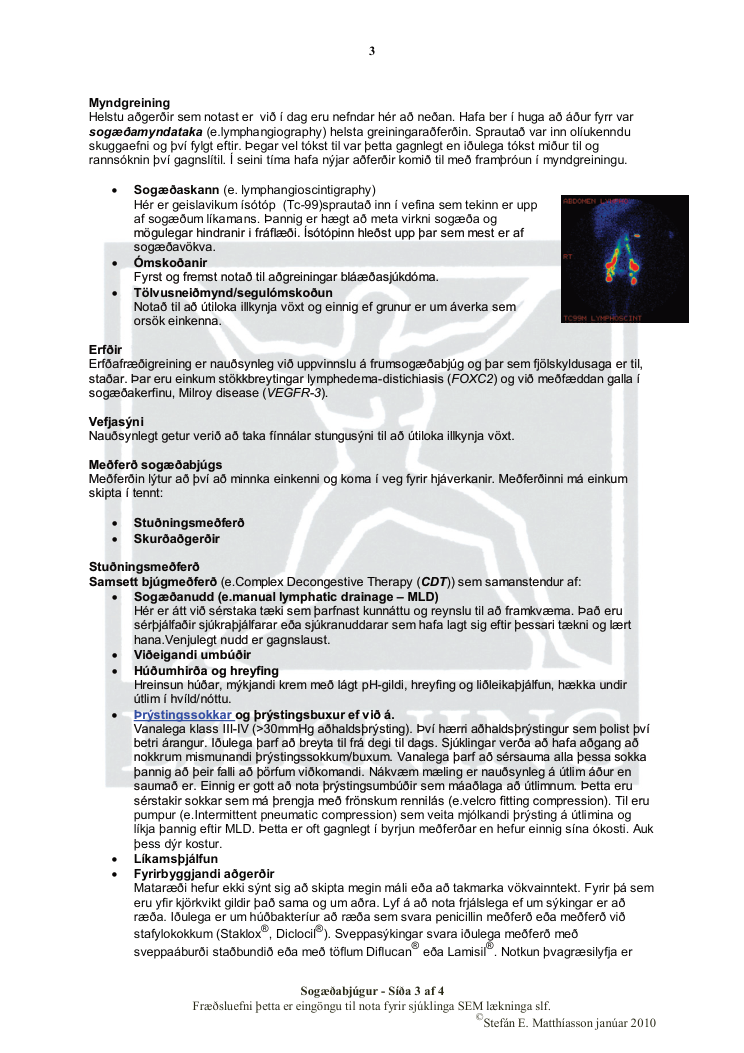
- Microsurgery Icelandic Health Insurance Icelandic Health Insurance (SÍ) covers elastic stockings (70% of the cost) for certain medical conditions and inserts (100% of the cost) if needed (there is, however, a maximum reimbursement). An application for assistive equipment from the patient's physician must be submitted to SÍ. SÍ rules are as follows: Regulation No. 460/2003 on TR grants for assistive devices, as subsequently amended 0406 Assistive devices for circulatory treatment: Compression stockings/compression devices are covered only for burns and chronic, severe venous/lymphatic problems or long-lasting and substantial fluid accumulation due to paralysis. For growing children, compression devices 040606 are covered at 90%, and for others at 70%. As a result of accidents for which TR is liable to pay compensation, this equipment is covered at 100. 04 06 06 Compression stockings/compression devices for arms, legs, and torso 70/90/100% 09 09 03 Stocking liners 100% In addition, SÍ contributes to the cost of MLD provided by licensed physiotherapists, but not massage therapists, for some reason. Lipedema (e. Lipoedema) It is sometimes confused with lymphedema but is a completely different condition. It affects primarily women and is characterized by an abnormal distribution and amount of fat under the skin from the waist or groin down to the instep. The instep, however, is normal. It can also occur on the arms, in which case the back of the hand is normal. It is an overgrowth of fatty tissue. There are no symptoms of pitting edema. It does not feel like lymphedema to the touch. It is rather soft to the touch. Bruises occur easily. It is often painful to the touch. Infections are not a problem as with lymphedema, except in later stages if accompanied by lymphedema. It gradually increases over time. However, it can be accompanied by lymphedema in later stages, joint disorders, venous diseases, and obesity. Treatment, however, is not unlike that for lymphedema: MLD, compression stockings (class I-II), and skin care. Weight loss and diuretics are of little benefit. These patients often have ankle deformity, with the ankles turning outward (e. valgus). Custom-made shoes (orthopedic shoes) help with this deformity. These individuals often have reduced self-image because of their appearance. They have often tried every weight-loss diet available without seeing any results from their efforts.
©SEM Jan 2010
Lymphedema - Page 4 of 4 Educational material intended solely for use by patients of SEM lækninga slf. ©Stefán E. Matthíasson January 2010
View the original page and images