Page 1 of the original document
SEM lækningar slf. Stefán E. Matthíasson dr. med. Diagnosis and treatment of surgical and vascular diseases Lágmúla 5, 2nd floor, 108-Reykjavík, Tel.: 590 9200, www.laekning.is
Elastic stockings - Compression stockings Elastic stockings are used for various medical conditions affecting the lower and upper limbs. Elastic stockings are effective in treating various diseases and in preventing pathological conditions. It is important to use stockings suited to each individual in terms of use and purpose. Elastic stockings are made from elastic thread or fabric into which rubber has been incorporated. An overview of the main material types and basic considerations when choosing elastic stockings is given below. The simplest approach is to divide elastic stockings into two main groups:
- Support stockings
- Compression stockings Elastic stockings are used in various situations. In general, their use helps speed up blood circulation in the limb: General indications:
- Tiredness, irritation in the legs
- Tendency to edema without a confirmed underlying disease Preventive indications:
- Prevention of blood clot formation For confirmed diseases:
- Varicose veins
- Other venous diseases
- Lymphedema
- After a venous blood clot
- After burns to the limbs
Contraindications Patients with confirmed peripheral arterial disease (atherosclerosis) and various other vascular syndromes should not
use compression stockings unless they have consulted their physician. The use of support stockings is
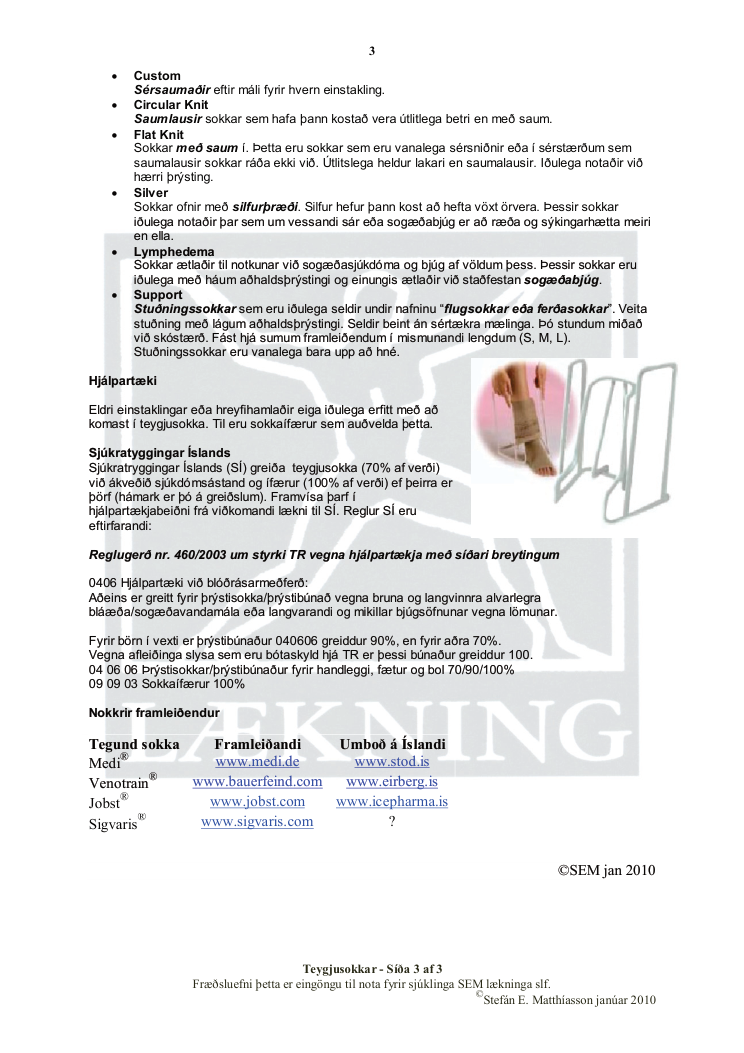
generally uncomplicated. Elastic stockings provide varying degrees of compression. This compression reflects the pressure exerted by the stockings. Compression pressure is measured in mmHg (millimeters of mercury) or kPa (kilopascals). Elastic stockings are generally sold in the following compression-pressure classes:
- Support stockings (usually only knee-high) Generally without measurements of the limb, or only shoe size is specified.
- 8-15 mmHg (mild compression)
- 8-20 mmHg (greater compression)
- Compression stockings (various standard sizes stocked by stores) Here, the different compression classes or pressure in mmHg must be prescribed according to the intended use. The circumference of the ankle/calf/thigh must be measured so that the stocking fits the individual.
- Compression stockings (custom-made to measurements) Classification used by several manufacturers for custom-made (e. custom made) stockings
Elastic stockings - Page 1 of 3 Educational material intended solely for use by patients of SEM lækninga slf
©Stefán E. Matthíasson January 2010
View the original page and images
Page 2 of the original document
2
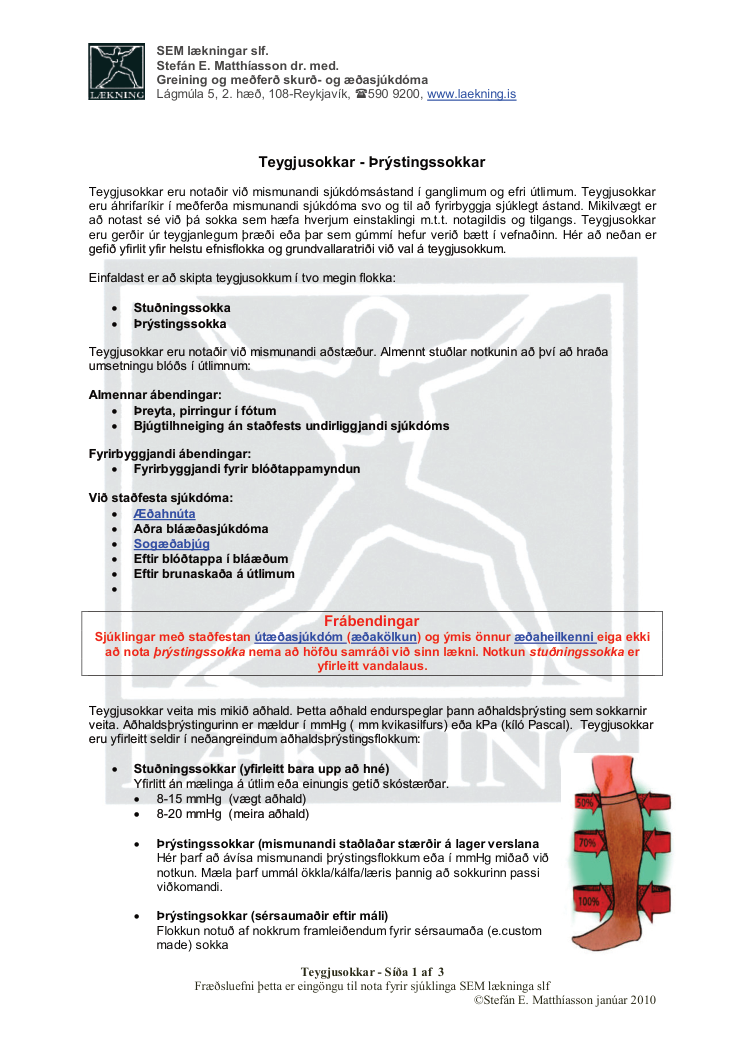
Class I-IV – Ccl 1-4 classification Ccl is a designation for standardized products that provide a specific compression pressure. In Iceland, these are generally referred to as “Class I-IV” stockings. The name refers to the stockings' graduated compression properties. The ankle is always taken as the reference point at 100%. This corresponds to 50-80% compression pressure at the calf and 20-50% compression pressure at the thigh. Unfortunately, Ccl standards differ between countries and continents, and products from these countries are not comparable.
Therefore, it is important to use direct compression-pressure values (mmHg) alongside the Class system when prescribing
stockings, so that it is clear which ones the individual should purchase.
The table is wide. Scroll sideways to see every column.
| European standard | British UK standard | USA standard | Indications for choosing stockings* |
|---|---|---|---|
| Ccl 1 Low compression 18 – 21 mm Hg (2,4 - 2,8 kPa) | Ccl 1 Low compression 15 – 20 mm Hg (2,0 - 2,7 kPa) |
| |
| Ccl 2 Moderate compression 23 – 32 mm Hg (3,1 - 4,3 kPa) | ccl 1 20-30 mm Hg (2,7 - 4,0 kPa) | Ccl 2 Moderate compression 20 – 30 mm Hg (2,7 – 4,0 kPa) |
|
| Ccl 3 High compression pressure 34 – 46 mm Hg (4,5 - 6,1 kPa) | ccl 2 30- 40 mm Hg (4,0 – 5,3 kPa) | Ccl 3 High compression pressure 30 – 40 mm Hg (4,0 – 5,3 kPa) |
|
| Ccl 4 Very high compression > 49 mm Hg (> 6,5 kPa) | Ccl 4 Very high compression > 49 mm Hg (> 6,5 kPa) |
|
*Guidelines, but there may be substantial differences between individuals
1 kPa = 7,5 mmHg and 1 mmHg = 0,133 KPa Compression stockings are manufactured in three main lengths. Within each category, manufacturers often offer different lengths (S, M, L):
- Knee-high (e. knee-high). Code on packaging: AD
- Thigh-high (e. thigh-high). Code on packaging: AG
- Pantyhose (e. pantyhose). Code on packaging: AT Common labels Various indications are often printed on stocking packaging. They may be unfamiliar to the general public, but manufacturers intend them as guidance for the purchaser. What do these labels mean?
- Anti-embolism For prevention of blood clots. Usually after surgery or during prolonged bed rest/immobility following illness or accidents. Also for those who have previously had a venous blood clot and are at increased risk of another clot.
Elastic stockings - Page 2 of 3 Educational material intended solely for use by patients of SEM lækninga slf. ©Stefán E. Matthíasson January 2010
View the original page and images
Page 3 of the original document
3
- Custom Made to measure for each individual.
- Circular Knit Seamless stockings, which have the advantage of looking better than seamed ones.
- Flat Knit Stockings with a seam. These stockings are usually custom-made or come in special sizes that seamless stockings cannot accommodate. They are less attractive in appearance than seamless stockings. Often used with higher compression.
- Silver Stockings woven with silver thread. Silver has the advantage of inhibiting the growth of microorganisms. These stockings are often used for weeping wounds or lymphedema, where the risk of infection is higher than otherwise.
- Lymphedema Stockings intended for use in lymphatic diseases and edema caused by them. These stockings often provide high compression and are intended only for confirmed lymphedema.
- Support Support stockings, often sold under the name “flight stockings or travel stockings”. They provide support with low compression pressure. Sold directly without specific measurements, though sometimes based on shoe size. Some manufacturers offer them in different lengths (S, M, L). Support stockings are usually only knee-high.
Assistive devices
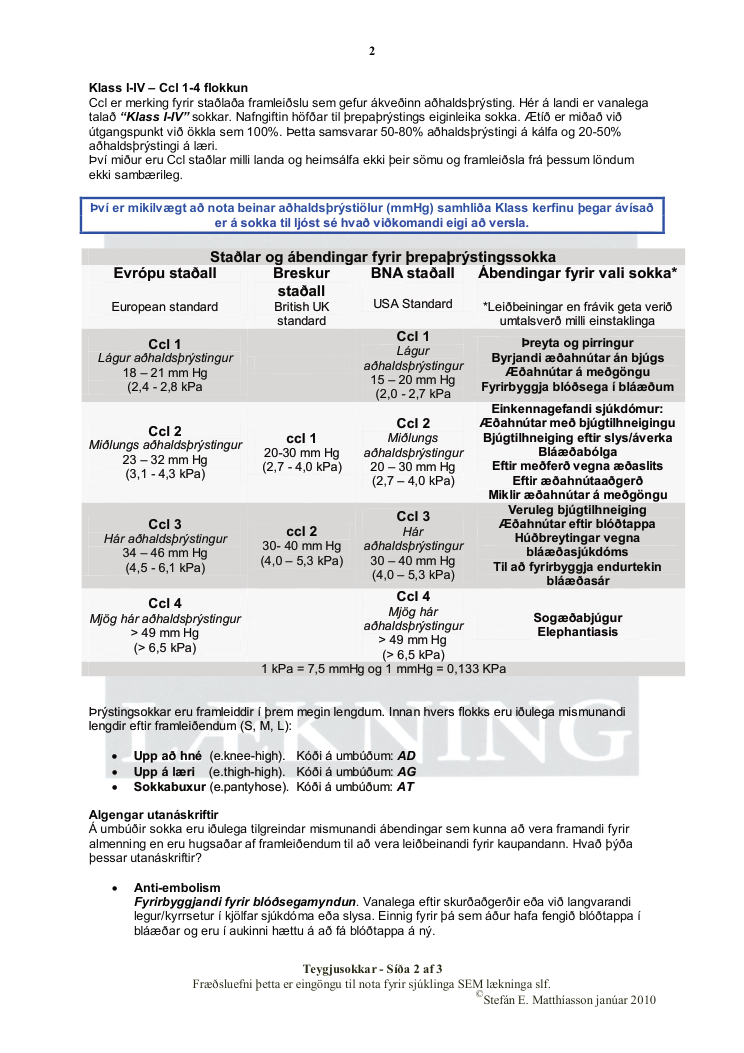
Older people and people with reduced mobility often have difficulty putting on elastic stockings. Stocking aids are available to make this easier.
Icelandic Health Insurance
Icelandic Health Insurance (SÍ) covers elastic stockings (70% of the cost) for certain medical conditions and stocking aids (100% of the cost) if needed (there is, however, a maximum reimbursement). An application for assistive equipment from the patient's physician must be submitted to SÍ. SÍ rules are as follows: Regulation No. 460/2003 on TR grants for assistive devices, as subsequently amended 0406 Assistive devices for circulatory treatment: Compression stockings/compression devices are covered only for burns and chronic, severe venous/lymphatic problems or long-lasting and substantial fluid accumulation due to paralysis. For growing children, compression devices 040606 are covered at 90%, and for others at 70%. As a result of accidents for which TR is liable to pay compensation, this equipment is covered at 100. 04 06 06 Compression stockings/compression devices for arms, legs, and torso 70/90/100% 09 09 03 Stocking aids 100%
Several manufacturers
Type of stocking Manufacturer Distributor in Iceland Medi® www.medi.de www.stod.is
Venotrain® www.bauerfeind.com www.eirberg.is Jobst® www.jobst.com www.icepharma.is
Sigvaris® www.sigvaris.com ?
©SEM Jan 2010
Elastic stockings - Page 3 of 3 Educational material intended solely for use by patients of SEM lækninga slf. ©Stefán E. Matthíasson January 2010
View the original page and images